




Pine pollen vs pine needle extract is a comparison of two different botanical materials. Pollen is reproductive material released by male pollen cones. Needles are the tree’s leaves. Even when both materials come from the same pine species, they should not be treated as the same ingredient.
This distinction affects product identity, extraction, serving information, storage, and research relevance. A pine pollen tincture is not a liquid version of pine needle extract. A needle extract is not concentrated pine pollen.
Are pine pollen and pine needle extract the same?
No. Pine pollen and pine needle extract come from different structures of a pine tree.
- Pine pollen is produced in male pollen cones as part of the tree’s reproductive cycle.
- Pine needles are leaves that remain on the branches and perform vegetative functions.
- Pine pollen products begin with pollen material.
- Pine needle extracts begin with needles or defined leafy material.
The shared word pine identifies a broad botanical source. It does not establish identical plant parts, compounds, processing methods, or serving amounts.
| Comparison point | Pine pollen | Pine needle extract |
|---|---|---|
| Plant material | Pollen grains | Needle-like leaves |
| Botanical role | Reproductive material | Vegetative and photosynthetic material |
| Source structure | Male pollen cones | Needles attached to shoots and branches |
| Common product forms | Powder, tincture, or dry extract | Liquid extract, dry extract, tea material, or powder |
| Main label term | Pollen | Needle, leaf, or aerial material |
| Interchangeable | No | |
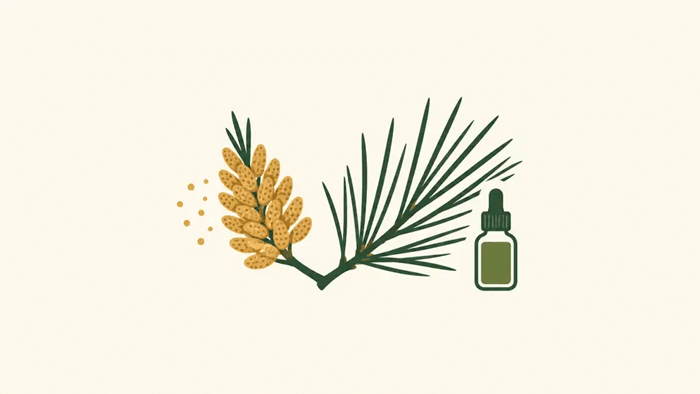
What is pine pollen?
Pine pollen consists of microscopic grains released by male pollen cones. Pine trees usually rely on wind to move the pollen toward receptive female cones.
A pollen product may contain raw pollen powder, processed pollen, a dried extract, or a liquid extract. The front label may not reveal which type is present. Check the Supplement Facts panel and ingredient list.
Pollen is not a needle by-product
Manufacturers do not create pollen by grinding needles. They collect pollen during a limited seasonal period when male cones release it. The resulting material has a different biological origin from harvested pine needles.
A current retail pine pollen tincture provides an example of the pollen-based liquid category. Its online listing offers alcohol and alcohol-free variants. That format information does not describe pine needle material.
Pollen format requires clarification
A pine pollen label should identify whether the contents are powder or extract. If the product is a tincture, the full label should also disclose the carrier or solvent. Alcohol-free does not automatically mean glycerin-based.
Processing terms such as whole pollen, cracked pollen, or broken cell wall need definitions. Those phrases do not by themselves establish higher quality or better absorption.
What is pine needle extract?
Pine needle extract begins with pine needles, which are specialized leaves. Manufacturers expose the needle material to water, alcohol, glycerin, or another disclosed extraction system. They may then sell the extract as a liquid or remove the solvent to make a dry powder.
The words pine needle extract do not define one standard product. Pine species, harvesting stage, fresh or dried material, extraction ratio, carrier, and concentration can vary.
Needle extract is not pine essential oil
A pine needle extract and a pine essential oil are different preparations. An extract can contain constituents transferred through a stated solvent process. An essential oil is a concentrated volatile fraction produced through methods such as distillation.
Do not substitute one term for the other on product pages, comparison charts, or research summaries. The manufacturing methods and finished materials differ.
Needle powder is another separate form
Ground pine needles are not automatically an extract. A true extract involves a process that transfers selected constituents from the starting material into another medium or concentrated preparation.
The label should distinguish ground needle material, liquid needle extract, dry needle extract, and essential oil.
Can both products come from the same pine species?
Yes, but a shared species would not make pollen and needles equivalent. They remain different plant parts with different biological roles.
They may also come from different pine species. The genus Pinus contains many species, and the phrase pine does not identify one of them. A reliable comparison requires the complete Latin botanical name on both labels.
For example, a product should identify its source with a genus and species rather than relying only on terms such as pine pollen or pine needles. If the species is missing from an online description, check the physical label or request the product specification.
Species matching is only the first step
After confirming species, compare the plant part, starting-material condition, extraction method, concentration, and amount per serving. A match in one field cannot replace missing information in the others.
Why does the plant part change the comparison?
Different plant structures perform different functions. Pollen participates in reproduction. Needles capture light, exchange gases, and support the tree’s vegetative activity.
Those roles produce different starting materials. An analysis of pollen does not automatically describe needles from the same tree. Research on a needle extract does not establish the composition or performance of a pollen tincture.
Research must match the tested material
Before applying a study to a product, check five details:
- The pine species
- The plant part
- The extraction method
- The finished product form
- The tested amount
A study that names only the genus may not provide enough detail. A laboratory study of isolated constituents also cannot describe every finished supplement made from the plant.
How do extraction methods differ?
Extraction changes how botanical material is presented. The term extract does not guarantee one concentration or one group of compounds.
Pine pollen extraction
A liquid pollen product may use alcohol, water, glycerin, or a combined carrier system. The label should identify the solvent and amount of total liquid extract. An extraction ratio can provide additional context when disclosed.
Pollen powder may contain unextracted pollen or a dry extract. These are not equivalent descriptions. Check what the declared weight represents.
Pine needle extraction
Needle extracts may use fresh or dried needles. The manufacturer may use water, alcohol, or another suitable carrier. Heat, extraction time, material-to-solvent ratio, and drying steps can further distinguish products.
Do not assume that two liquid products are comparable because both come in dropper bottles. One may be a pollen tincture while the other contains pine needle extract.
What should you compare on the labels?
Start with the physical label. An online headline may simplify the ingredient name, while the Supplement Facts and Other Ingredients sections provide more useful detail.
| Label field | Why it matters | What to look for |
|---|---|---|
| Botanical name | Identifies the pine species | Full genus and species |
| Plant part | Separates pollen from needles | Pollen, needle, or leaf |
| Material type | Distinguishes powder from extract | Raw powder, liquid extract, or dry extract |
| Serving size | Defines the labeled measurement | Drops, milliliters, grams, or capsules |
| Amount per serving | Supports a quantitative comparison | Declared weight or liquid-extract amount |
| Carrier or solvent | Clarifies the liquid formula | Alcohol, water, glycerin, or another ingredient |
| Lot information | Connects the bottle to batch records | Lot number and matching test documents |
FDA labeling guidance for US dietary supplements requires botanical ingredients to identify the plant part in the Supplement Facts panel. The panel should also state the serving size and quantitative amount.
Can pine pollen replace pine needle extract?
No general substitution can be assumed. The products begin with different botanical materials and may use different manufacturing processes.
A routine built around one format should not be transferred to another product without reading the new label. Serving units can also differ. Drops of pollen tincture cannot be converted into grams of needle extract without detailed composition and concentration information.
Product names that contain pine are not enough to support equivalence. The same rule applies to research, buying guides, and comparison tables.
How do storage and handling differ?
Storage depends on the finished format rather than the tree alone. Follow the instructions printed on each product.
Liquid extracts
Keep the cap closed securely. Avoid touching the dropper to the mouth or another surface. Follow label instructions concerning heat, light, and refrigeration.
Dry powders
Keep the container tightly sealed and use a clean, dry scoop. Moisture can cause clumping and make consistent measurement harder.
Essential oils
Store essential oils according to their own packaging and handling directions. Do not apply instructions for a pollen tincture or powdered needle extract to a volatile oil.
What safety details deserve attention?
Review the full ingredient list, allergen information, cautions, and intended-use directions. Products from different pine materials may carry different label statements.
Do not infer safety from the word natural or from a history of traditional use. Anyone who is pregnant, nursing, taking medication, or concerned about pollen sensitivity should discuss supplement use with an appropriate healthcare professional.
Batch testing should be read by test category. Identity testing, microbial analysis, heavy-metal screening, and solvent testing answer different questions. A generic tested claim does not explain which analyses were completed.
Pine Product Identity Checklist
Use this checklist before comparing a pine pollen product with pine needle extract. It helps separate botanical identity from packaging, marketing language, and format.
Find the species
Record the complete Latin name from each physical label. Do not rely on the word pine alone.
Confirm the plant part
Check whether the product uses pollen, needles, leaves, cones, bark, or another material.
Identify the preparation
Determine whether the contents are raw powder, liquid extract, dry extract, tea material, or essential oil.
Read the extraction details
Look for the carrier, extraction ratio, and fresh or dried starting-material information.
Check the serving amount
Record the serving unit and quantitative amount. Do not convert between formats without supporting data.
Match research carefully
Use studies that match the species, plant part, preparation, amount, and research design.
Review storage instructions
Follow the directions for the finished product rather than applying one format’s rules to another.
Verify the lot
Match available test records to the lot number on the container and review the actual test scope.
FAQ
Is pine pollen the same as pine needle extract?
No. Pollen is reproductive material, while needles are leaves. Products made from them are not interchangeable.
Do pine pollen and needles come from the same tree?
They can come from the same tree or species, but product labels must confirm the botanical source.
Is pine pollen made by grinding pine needles?
No. Pine pollen comes from male pollen cones. Ground needles are a separate botanical material.
Is pine needle essential oil the same as needle extract?
No. Essential oil is a concentrated volatile fraction, while an extract depends on a separate extraction process.
Can pine pollen research apply to pine needle products?
Not automatically. The study must match the species, plant part, preparation, and tested amount.
Which product is more concentrated?
The names cannot answer that question. Compare extraction ratios and declared amounts on the specific labels.
Can drops of pollen tincture equal a gram of needle extract?
No direct conversion is possible without concentration and starting-material data for both products.
What is the fastest way to distinguish the products?
Read the botanical name and plant part in the Supplement Facts panel. Look specifically for pollen or needle.
Glossary
Pine pollen
Reproductive grains released by male pine pollen cones.
Pine needle
A specialized leaf found on a pine tree.
Pollen cone
A male pine structure that produces and releases pollen.
Botanical material
The specific plant tissue used to make a product.
Plant part
The identified structure used, such as pollen, leaf, root, bark, or seed.
Extract
A preparation made by transferring selected constituents from botanical material into another medium.
Essential oil
A concentrated volatile fraction obtained through a suitable production method.
Extraction ratio
The stated relationship between starting botanical material and finished extract.
Botanical name
The scientific genus and species used to identify a plant.
Lot number
A code connecting a finished product with a specific manufacturing batch.
Conclusion
Pine pollen and pine needle extract can come from the same species but remain different botanical materials. Compare the species, plant part, preparation, serving amount, and extraction details before connecting products or research.
Sources Used
Botanical description of pine needles, pollen cones, and seasonal pollen release, Scots pine species review – research.fs.usda.gov/feis/species-reviews/pinsyl
Description of male pollen cones, female cones, and wind pollination in pine, southwestern white pine species review – research.fs.usda.gov/feis/species-reviews/pinsto
Pine cone and pollen development reference, US Forest Service publication – srs.fs.usda.gov/pubs/gtr/gtr_se013.pdf
Requirements for plant-part, serving-size, liquid-extract, and dry-extract declarations, FDA Dietary Supplement Labeling Guide – fda.gov/food/dietary-supplements-guidance-documents-regulatory-information/dietary-supplement-labeling-guide-chapter-iv-nutrition-labeling
Current example of a pollen-based liquid pine product, retail product listing – secrets.shop/products/pine-pollen-tincture